

Table of contents
- What Play-Based Learning Actually Means
- Why Play-Based Learning Matters
- What Play-Based Learning Looks Like in a Classroom
- Play-Based Learning vs Academic-Style Preschool
- Signs a Preschool Takes Play-Based Learning Seriously
- How Petals Kids Approaches Play-Based Learning
- How Parents Can Support Play-Based Learning at Home
- Frequently Asked Questions
- Choosing a Preschool That Gets Play-Based Learning Right
Ask any parent what they remember about their own early school years, and it is rarely a worksheet. It is usually a game, a story, a mess made with paint or blocks stacked a little too high. That memory is not a coincidence. For children under six, play is not a break from learning, it is how learning actually happens. This guide explains what play-based learning really means, why it works, and what to look for when you are evaluating a preschool for your child.
What Play-Based Learning Actually Means
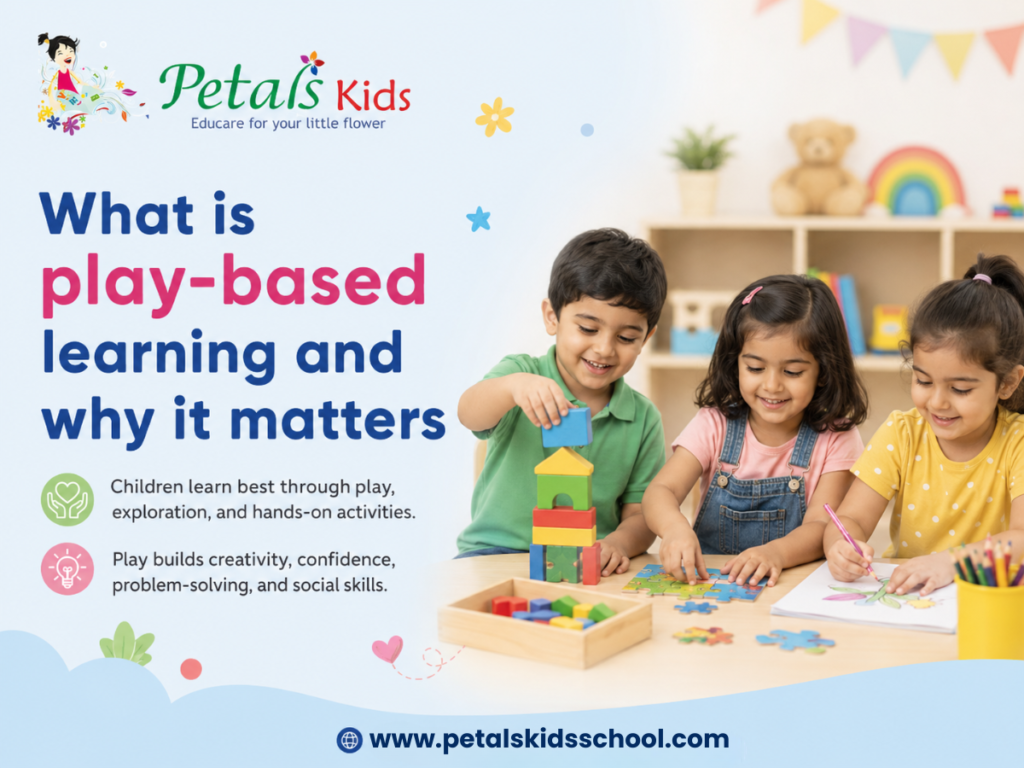
Play-based learning is a teaching approach where children build knowledge and skills through activities they choose and direct themselves, guided gently by a teacher rather than instructed at every step. A child stacking blocks is quietly absorbing concepts of balance, height and cause and effect. A child pretending to run a shop with friends is practising language, turn-taking and basic counting, all without realising they are learning at all.
This is different from rote or academic-style teaching, where a child is told what to do and expected to repeat it correctly. Play-based learning flips that order. The child leads, and the curriculum is built around what naturally happens during that play.
Why Play-Based Learning Matters
- It builds real understanding, not memorisation. A child who counts out snacks for friends understands numbers differently than one who repeats numbers on command.
- It develops social and emotional skills alongside academic ones. Sharing toys, waiting for a turn and resolving a small disagreement with a friend are skills no worksheet can teach.
- It keeps a child’s natural curiosity alive. Children who enjoy learning early tend to carry that curiosity into later years of school, rather than viewing learning as something to get through.
- It supports brain development at the right pace. Young children’s brains are not ready for abstract, symbol-based learning the way a six or seven year old’s brain is. Play matches the way their brain is actually developing.
- It reduces pressure and anxiety. A child who is playing does not feel evaluated the way a child filling out a worksheet might. Lower pressure at this age supports confidence later.
What Play-Based Learning Looks Like in a Classroom
A well-run play-based classroom is not unstructured chaos, and it is not a free-for-all. Good play-based learning is carefully planned, even when it looks spontaneous. Common activities include:
- Building and construction play using blocks, that quietly teaches maths, engineering concepts and problem-solving
- Pretend play and role play, such as a play kitchen or doctor’s clinic, that builds language and social understanding
- Sensory play with sand, water, textures and colours, that supports early science thinking
- Storytelling and picture books, that build vocabulary and comprehension
- Outdoor and movement-based play, that develops gross motor skills and body awareness
- Art and music activities, that support creativity and fine motor control
This is the same thinking that shapes our teaching philosophy at Petals Kids, where every activity is chosen with a specific developmental purpose in mind, not just to fill classroom time.
Play-Based Learning vs Academic-Style Preschool
| Aspect | Play-Based Learning | Academic-Style Teaching |
| How children learn | Through self-directed activity and exploration | Through direct instruction and repetition |
| Teacher’s role | Guide and observer, steps in when needed | Instructor, leads every activity |
| Typical activities | Blocks, pretend play, art, outdoor time | Worksheets, writing drills, memorisation |
| Pace | Follows the child’s interest and readiness | Follows a fixed curriculum timeline |
| Pressure on the child | Low, learning feels like play | Higher, learning feels like a task |
| Suited for | Children under 6 years | Children in later primary years |
Signs a Preschool Takes Play-Based Learning Seriously
Not every preschool that says “play-based” actually runs one well. Here is what to look for during a visit:
- Activity corners set up for building, pretend play, art and reading, not just rows of desks
- Teachers who join a child’s play and ask open-ended questions, rather than only giving instructions
- A visible weekly plan that shows how each activity connects to a developmental goal
- Time set aside for outdoor and unstructured play every single day, not just occasionally
- Teachers who can explain what a specific activity was building, beyond “the children enjoyed it”
How Petals Kids Approaches Play-Based Learning
At Petals Kids, play-based learning is not treated as free time between lessons, it is the lesson. Every activity, from block play to storytelling to outdoor games, is mapped to a specific developmental outcome within the six-domain Outcome-Based Activity Curriculum, covering physical, cognitive, language, social-emotional, creative and personal independence growth.
This is one of the reasons many parents choose Petals Kids for their child’s early years. The curriculum stays consistent across every branch, so whether a family is in Wakad, Ravet or Akurdi, their child gets the same thoughtfully designed play experience, guided by trained teachers who understand exactly what each activity is building, not just how to keep children occupied for a few hours.
How Parents Can Support Play-Based Learning at Home
- Set aside unstructured playtime at home, without screens, even 30 minutes a day makes a difference
- Follow your child’s interest rather than directing the play, if they want to stack cups for the tenth time, let them
- Ask open-ended questions during play, such as “what happens if we add one more block”, instead of giving answers directly
- Keep some open-ended toys at home, such as blocks, art supplies and dress-up items, rather than only toys with one correct way to use them
- Read together daily, and let your child act out or retell the story in their own words
Frequently Asked Questions
What age is play-based learning best suited for?
Play-based learning is most effective for children between 1.5 and 6 years, which covers playgroup through senior KG. This is the period when a child’s brain is developing rapidly through sensory and social experience rather than abstract instruction.
Is play-based learning the same as unstructured free play?
No. Play-based learning looks relaxed but is carefully planned by teachers around specific developmental goals. Free play at home, where a child plays without any guidance, is valuable too, but a good play-based classroom combines both structure and freedom.
Will my child fall behind academically with a play-based approach?
Most early childhood research suggests the opposite. Children who build strong foundational skills through play, including language, social understanding and problem-solving, tend to adapt more easily to formal academics later, since they are not starting from a place of pressure or anxiety.
How is play-based learning different from Montessori?
Montessori is one specific method within the broader play-based learning approach, with its own materials and structure. Play-based learning is the wider category, many preschools blend play-based principles with elements from Montessori, Reggio Emilia or their own curriculum framework.
How can I tell if a preschool’s play-based learning is genuine or just a label?
Ask teachers what a specific activity was designed to build, and look at whether the answer goes beyond “the children have fun.” A genuine play-based programme has a clear developmental purpose behind every activity, even ones that look simple.
Does play-based learning include any academic content at all?
Yes, gently. Pre-literacy and pre-numeracy concepts are introduced through songs, stories and games rather than worksheets or writing drills, especially from the nursery stage onward.
Choosing a Preschool That Gets Play-Based Learning Right
Play-based learning is not a trend, it reflects how young children are naturally built to learn. When you are evaluating a preschool, look past the phrase itself and ask what is actually happening in the classroom, how teachers are trained, and how each activity connects to your child’s development.
Parents who want to see this approach in action are welcome to visit a Petals Kids branch near them and spend time observing a real session before making a decision.

Archana Khosla is a Doctor (in Ayurvedic Medicine) by profession and an Educationist by passion. She is the favorite of every child at Petals Kids, and is patient by nature. She’s a Trained Montessori Teacher, Diploma in “Daycare Management, Certified “Parenting Coach” & “Play Therapist”, Life-time member of “Early Childhood Association” (ECA).
Archana has been in the Child Care and Education field for more than 20 years. In line with Petals vision to achieve excellence in providing progressive education & care i.e., “Educate for your little flower”. She strongly believes in continuous enhancement of her skills, as well of her team.
Dr. Archana Khosla
Archana Khosla is a Doctor (in Ayurvedic Medicine) by profession and an Educationist by passion. She is the favorite of every child at Petals Kids, and is patient by nature. She's a Trained Montessori Teacher, Diploma in "Daycare Management, Certified "Parenting Coach" & "Play Therapist", Life-time member of "Early Childhood Association" (ECA).
Archana has been in the Child Care and Education field for more than 20 years. In line with Petals vision to achieve excellence in providing progressive education & care i.e., "Educate for your little flower". She strongly believes in continuous enhancement of her skills, as well of her team.