

Table of contents
- Playgroup vs Nursery: Right Stage for Your Child at Petals Kids
- What Playgroup Is Designed For
- What Nursery Is Designed For
- How to Decide Which Stage Is Right for Your Child
- What to Expect on the First Day of Playgroup or Nursery
- Playgroup and Nursery Admissions in Pune: What Parents Should Know
- Why the Outcome-Based Activity Curriculum Matters at This Stage
- How Siblings and Twins Are Sometimes Placed Differently
- What Parents Should Ask During a Campus Visit
- How Parents Can Support the Transition at Home
- Frequently Asked Questions
- Making the Right First Step
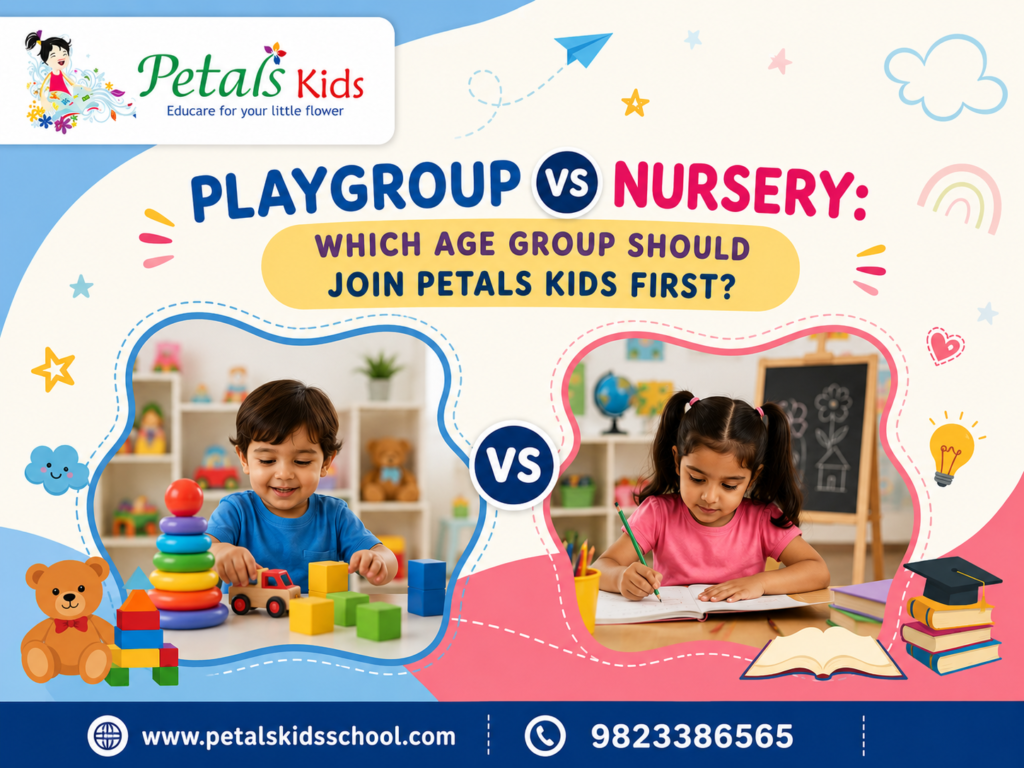
Playgroup is for children aged 1.5 to 2.5 years. The nursery is for children around 3 years of age. The right starting point is not just about your child’s birthday – it depends on how comfortable they are with short separations and being around other children. If you are unsure which stage suits your child, Petals Kids’ admissions team will assess readiness individually during the enrolment conversation.
One of the most common questions parents ask when researching early education is the difference between playgroup and nursery, Right Stage for Your Child at Petals Kids and which one is the correct starting point for their child. The terms are sometimes used loosely across different preschools, which adds to the confusion, particularly for first-time parents. This guide explains the typical age bands, what each stage is designed to build, and how to decide which one your child should begin with.
Playgroup vs Nursery: Right Stage for Your Child at Petals Kids
| Aspect | Playgroup | Nursery |
| Typical age | 1.5 to 2.5 years | Around 3 years |
| Primary focus | Sensory exploration and separation comfort | Structured play with gentle pre-literacy and numeracy |
| Session length | 2 to 3 hours with frequent breaks | Moderately longer, more structured routine |
| Group activities | Parallel play alongside peers | Guided group games and turn-taking |
| Academic content | Minimal to none | Introduced gently through songs and play |
| Next stage | Nursery | Junior KG |
What Playgroup Is Designed For
Playgroup is typically the very first formal early education stage a child experiences, generally starting between one and a half and two and a half years of age. The focus at this stage is almost entirely on social exposure and sensory development, not academic content of any kind.
A well-designed playgroup programme centres around:
- Short periods of separation from a primary caregiver, building gradual comfort with a new environment
- Sensory play involving textures, sounds, colours, and simple cause-and-effect activities
- Basic social exposure, including parallel play alongside other children of a similar age
- Gross motor activities such as crawling, walking, climbing, and simple movement games
- Early language exposure through songs, rhymes, and simple back-and-forth interaction with teachers
Playgroup sessions are usually two to three hours long. Very young children have limited attention spans and need frequent breaks, naps, and feeding schedules built into their day.
What Nursery Is Designed For
Nursery typically follows playgroup and is generally suited to children around three years of age. By this point, most children have built enough comfort with separation and group settings that the curriculum can introduce slightly more structured activities, while still remaining firmly play-based.
A nursery programme typically includes:
- Slightly longer structured activity blocks, including guided group games and simple craft projects
- Early pre-literacy exposure through letter sounds introduced via stories and songs, not writing drills.
- Early numeracy through counting games, sorting, and pattern recognition activities
- Greater emphasis on turn-taking, sharing, and following simple multi-step instructions
- Introduction to classroom routines that prepare children for the more structured Junior KG stage that follows
How to Decide Which Stage Is Right for Your Child
Age is a useful starting point, but readiness matters just as much. Consider these four questions before making a decision:
- How comfortable is your child with brief periods away from you or another primary caregiver?
- How does your child respond to being around other children of a similar age, even briefly?
- Can your child communicate basic needs, even non-verbally, to an unfamiliar adult?
- Has your child had any prior exposure to a structured group setting, such as a parent-and-child class?
A child who is older than the typical playgroup age but has had little prior exposure to group settings may still benefit from starting at playgroup rather than being placed directly into nursery. The social and emotional groundwork built at playgroup supports a smoother transition later.
5 Signs Your Child Is Ready for Nursery
If your child is around three years old and shows most of the following, nursery is likely a good fit:
- They can stay calm for 20 to 30 minutes without needing a parent in the room.
- They show curiosity about other children and attempt basic interaction.
- They can follow a simple two-step instruction from an adult they do not know well.
- They can communicate basic needs, whether through words, gestures, or pointing.
- They have had some prior exposure to a playgroup, mother-toddler class, or similar group setting.
Your child does not need to tick every box. If three or four of these are true, a conversation with the admissions team is a good next step.
What to Expect on the First Day of Playgroup or Nursery
The first day is more about observation than activity. Here is a realistic picture of what usually happens:
- Drop-off is brief and structured. Teachers are trained to take over quickly so goodbyes do not drag out, which actually helps children settle faster.
- The first session is mostly free play and exploration. There is no pressure to participate in group activities on day one.
- Teachers observe how a child interacts, what draws their attention, and how they respond to unfamiliar sounds and spaces.
- Parents may be asked to stay nearby for the first two or three sessions, depending on the child’s comfort level.
- At pick-up, the teacher gives a brief verbal note on how the child spent their time, what they responded to, and any observations worth sharing.
Tears on day one are completely normal and do not indicate the wrong placement. Most children settle within one to two weeks. If a child is still visibly distressed beyond the third week, the admissions team will review the stage placement.
Playgroup and Nursery Admissions in Pune: What Parents Should Know
In Pune and the PCMC area, most preschools, including those in Wakad, Hinjewadi, Baner, and Aundh, open admissions for the next academic year between January and March. The academic year typically begins in June.
A few things specific to Pune parents to keep in mind:
- Playgroup seats fill quickly in areas like Wakad and Hinjewadi, where the under-3 population has grown sharply in recent years. Enquiring in November or December gives you more choice.
- Many Pune preschools ask for a birth certificate and a passport-size photo at enrolment, but readiness-based placement conversations are becoming more common at quality schools.
- If you are considering multiple campuses across Pune, visit at least one during school hours, not just during an open day, so you see a real session in progress.
Why the Outcome-Based Activity Curriculum Matters at This Stage
Petals Kids structures both playgroup and nursery within its six-domain Outcome-Based Activity Curriculum, which spans physical, cognitive, language, social-emotional, creative, and personal independence domains.
Because every activity at both stages is mapped to a specific developmental outcome rather than chosen for entertainment value alone, the transition between playgroup and nursery is designed to be a gradual progression rather than an abrupt jump in expectations.
Early childhood education research, including guidelines from NCERT’s Early Childhood Care and Education framework, consistently notes that abrupt increases in structure at a young age can increase anxiety and resistance to school. A gradual, outcome-mapped approach supports a more confident transition.
How Siblings and Twins Are Sometimes Placed Differently
Parents with twins or children close in age sometimes assume both children should start at the same stage. Early childhood educators generally advise against this when there is a meaningful gap in social or emotional readiness between two children, even if they share a birthday.
Placing a less ready child into a more structured nursery setting purely for the convenience of a shared schedule can create avoidable stress for that child. Petals Kids assesses each child individually during the enrolment conversation, even within the same family.
What Parents Should Ask During a Campus Visit
Whether considering a playgroup or a nursery, these questions reveal how thoughtfully a preschool has designed its early stages:
- How do you handle a child’s first days of separation anxiety? Ask for a specific description, not a general reassurance.
- How do teachers track individual progress at this age? Informal developmental notes shared with parents regularly are more meaningful than formal report cards for two- and three-year-olds.
- What does a typical day look like hour by hour, including how much time is spent outdoors?
- What is the teacher-to-child ratio in a playgroup and nursery specifically?
- How do you communicate with parents if a child is having a difficult week?
How Parents Can Support the Transition at Home
Whether your child is starting playgroup or nursery, a few simple habits at home can make the first few weeks much easier:
- Establish a consistent morning routine two to three weeks before the start date so the child can anticipate what is coming.
- Read simple books about starting school or going to a new place. This gives children language to describe what they might feel on day one.
- Keep goodbye routines brief and consistent at drop-off. Children take emotional cues from how a parent behaves at the moment of separation, so a calm, quick goodbye tends to help more than a prolonged one.
- After school, ask open-ended questions like ‘what did you play today’ rather than ‘did you have fun’, which is easier for young children to answer.
- Do not schedule anything demanding on school days for the first two to three weeks. Young children use a lot of emotional energy adjusting to new environments and often need quiet time at home after school.
Frequently Asked Questions
At what age can my child join the playgroup at Petals Kids?
Petals Kids generally accepts children into playgroup from around one and a half to two years of age. Exact eligibility is confirmed during the admissions conversation based on the child’s readiness, not just the birth certificate.
Can my child skip playgroup and start directly at nursery?
This depends on the child’s age and prior exposure to group settings. Some children who are closer to three and have had regular exposure to other children and structured environments can start directly at nursery. Petals Kids’ admissions team assesses readiness individually rather than applying a single rigid rule.
Is a playgroup necessary before nursery?
Playgroup is not a mandatory requirement before nursery, but it does build the foundational skills that make nursery easier. Children who have been through playgroup typically adjust to nursery routines more quickly because they already have experience with short separations and group play.
What is the difference between playgroup and LKG?
Playgroup is the earliest stage, focused entirely on sensory play and social comfort. LKG (Lower Kindergarten) comes two stages later, after nursery, and involves more structured learning, longer sessions, early writing readiness and a proper classroom routine. Playgroup and LKG are not interchangeable.
Can a 2-year-old go directly to nursery?
Generally, no. Most nursery programmes are designed for children around three years of age. A two-year-old would typically benefit more from the shorter, gentler structure of playgroup first. If a two-year-old is exceptionally socially and emotionally mature, the admissions team will advise accordingly after a direct assessment.
Is there academic content in a playgroup or nursery?
Both stages remain primarily play-based. Nursery introduces gentle pre-literacy and numeracy exposure through stories, songs and games. There are no worksheets or formal writing drills at either stage.
How long are playgroup and nursery sessions at Petals Kids?
Playgroup sessions are generally two to three hours to match a younger child’s attention span. Nursery sessions are somewhat longer, though both remain shorter than the full-day schedule of Junior KG and Senior KG.
What happens after nursery?
Children typically progress from nursery into Junior KG and then Senior KG, with each stage building gradually on the skills and routines established in the stage before it.
Making the Right First Step
Parents who are unsure which stage suits their child are encouraged to speak directly with the Petals Kids admissions team. A 15-minute conversation is usually enough to identify the right starting point based on your child’s current stage of development. Ready to get started? Contact Petals Kids today or Book an Admission Consultation to find the best program for your little one.

Archana Khosla is a Doctor (in Ayurvedic Medicine) by profession and an Educationist by passion. She is the favorite of every child at Petals Kids, and is patient by nature. She’s a Trained Montessori Teacher, Diploma in “Daycare Management, Certified “Parenting Coach” & “Play Therapist”, Life-time member of “Early Childhood Association” (ECA).
Archana has been in the Child Care and Education field for more than 20 years. In line with Petals vision to achieve excellence in providing progressive education & care i.e., “Educate for your little flower”. She strongly believes in continuous enhancement of her skills, as well of her team.
Dr. Archana Khosla
Archana Khosla is a Doctor (in Ayurvedic Medicine) by profession and an Educationist by passion. She is the favorite of every child at Petals Kids, and is patient by nature. She's a Trained Montessori Teacher, Diploma in "Daycare Management, Certified "Parenting Coach" & "Play Therapist", Life-time member of "Early Childhood Association" (ECA).
Archana has been in the Child Care and Education field for more than 20 years. In line with Petals vision to achieve excellence in providing progressive education & care i.e., "Educate for your little flower". She strongly believes in continuous enhancement of her skills, as well of her team.