

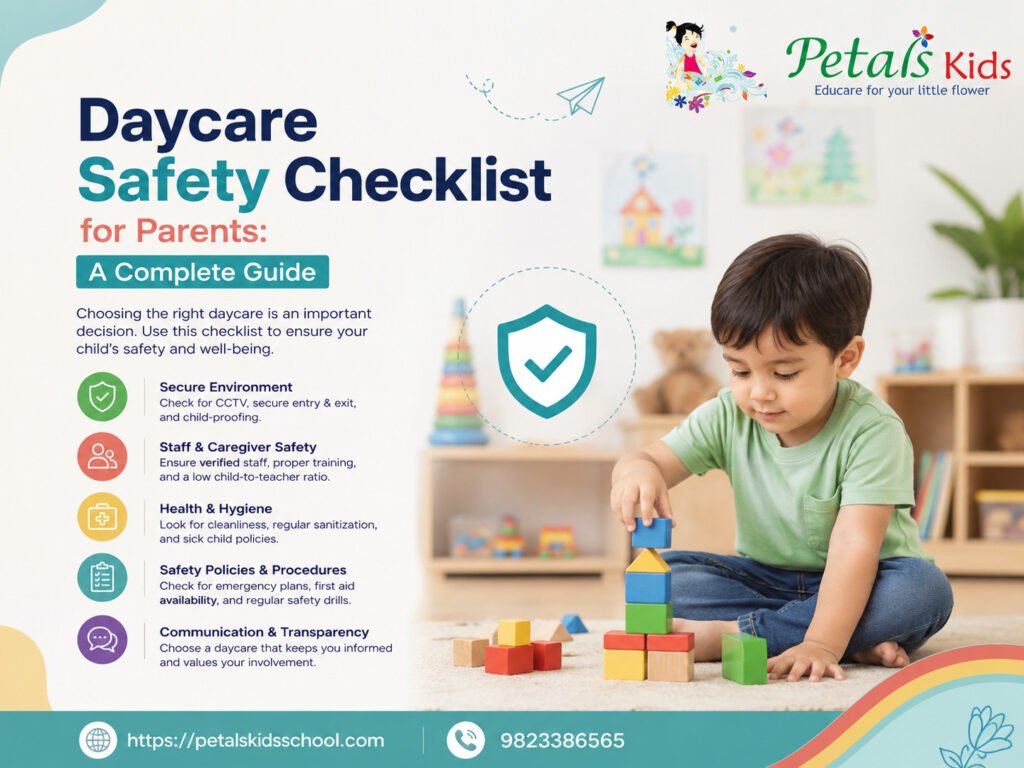
Table of contents
- Introduction
- Quick Facts: Daycare Safety Standards Parents Should Expect
- Why a daycare safety checklist for parents Matters Before You Enroll
- The complete daycare safety checklist for parents
- Questions to Ask During a Daycare Visit
- Red Flags to Watch For When Choosing a Daycare
- Daycare Safety at Petals Kids: Serving Wakad, Ravet, Balewadi, Baner, Salunkhe Vihar and NIBM
- Frequently Asked Questions
- Conclusion
Key Takeaways of daycare safety checklist for parents
- A safe daycare should show visible childproofing across the entire premises before you enrol, not promises to add it later.
- Caregiver-to-child ratio is one of the strongest predictors of safety and matters most in rooms for infants and toddlers.
- Background verification of every staff member, including support staff, should be non-negotiable when you shortlist a daycare.
- CCTV coverage of all indoor and outdoor areas, with footage accessible to parents on request, is now standard at well-run daycare centres in Pune.
- A written emergency evacuation plan and a stocked, accessible first aid kit are basic requirements, not extras.
- Daily health screening at drop-off helps prevent illness from spreading among children in the same room.
- A daycare that welcomes unannounced parent visits generally has nothing to hide about its day-to-day safety practices.
Introduction
Choosing a daycare is one of the hardest decisions a parent makes. You are handing over your child’s safety to people you may have met only once or twice, in a building you will not be inside for most of the day.
A daycare safety checklist for parents gives you a structured way to evaluate a centre instead of relying on how friendly the reception felt or how nice the brochure looked. At Petals Kids in Wakad, we get asked about safety in almost every enrolment conversation with families from Wakad, Ravet, Balewadi, Baner, Salunkhe Vihar and NIBM, and this guide covers exactly what to look for, what questions to ask and what should raise concern.
Quick Facts: Daycare Safety Standards Parents Should Expect
| Label | Fact |
| Ideal caregiver to infant ratio | 1:3 to 1:4 |
| Ideal caregiver to toddler ratio | 1:5 to 1:6 |
| CCTV coverage expected | All indoor and outdoor common areas |
| Staff background verification | Police verification and reference checks for all staff |
| First aid trained staff on site | At least one present during all operating hours |
| Fire safety essentials | Fire extinguishers, marked exits, displayed evacuation plan |
| Daily health check | Temperature and visible symptom check at drop-off |
Why a daycare safety checklist for parents Matters Before You Enroll
A daycare looks different on a quick tour than it does on a normal Tuesday afternoon. Toys are put away, staff are on their best behaviour and the room you see is usually the cleanest one in the building.
A checklist stops you from being swayed by first impressions alone. It gives you specific, checkable items covering the building, the staff, the food, the hygiene practices and the emergency planning, so you are comparing centres on facts rather than feelings. It also gives you a reference point to come back to after enrolment, so you can notice if standards slip over time.
The complete daycare safety checklist for parents
1. Facility and Infrastructure Safety
- Childproofed furniture with rounded edges and no sharp corners at child height
- Electrical socket covers on every accessible point
- Safety gates on stairs and near exits
- Secure boundary walls or fencing around outdoor play areas
- Non-toxic paint and cushioned, non-slip flooring
- Fire extinguishers installed and within their inspection date
- Clearly marked emergency exits that are never blocked or locked during operating hours
2. Staff and Caregiver Safety
- Police verification completed for every staff member, not only classroom teachers
- Reference checks done before hiring, not after
- Caregiver-to-child ratio maintained in practice, not just stated in policy documents
- At least one staff member trained in paediatric first aid and CPR present at all times
- Staff trained to recognise and report signs of injury or distress in a child
- No single caregiver left alone with a child behind a closed door
3. Hygiene and Health Safety
- Daily sanitisation of toys, mats and frequently touched surfaces
- Handwashing built into the daily routine, especially before meals and after washroom use
- Health screening at drop-off, including a basic temperature check
- A clear policy on sending home a child who is unwell
- Clean, child-height washroom facilities
- A separate area to keep a child who becomes unwell during the day, away from other children
4. Food and Nutrition Safety
- Age-appropriate menu shared with parents in advance
- A clear allergy protocol, with each child’s allergy information recorded and visible to staff who handle food
- Hygienic kitchen with visible cleanliness standards
- Safe, regularly checked drinking water source
- No sharing of food or utensils between children without proper cleaning in between
5. Emergency Preparedness
- Written evacuation plan displayed and practiced with children through regular drills
- Stocked, easily accessible first aid kit
- Emergency contact numbers for every child on file and quickly accessible to staff
- Nearest hospital identified in advance and kept on record
- A clear protocol for what happens if a parent cannot be reached during an emergency
6. CCTV and Monitoring
- CCTV coverage across indoor and outdoor common areas, not only the entrance
- Parents allowed to request footage review when they have a concern
- Cameras checked regularly to confirm they are working
- Privacy respected in washroom and changing areas, with monitoring focused on common and play areas
7. Communication and Transparency
- Daily updates to parents through notes, photos or an app-based report
- Open-door policy that allows unannounced parent visits
- A clear, responsive process for raising concerns
- Regular opportunities for parent-teacher interaction beyond drop-off and pickup
Questions to Ask During a Daycare Visit
Carrying your checklist is useful, but asking the right questions out loud tells you a lot about how a daycare handles scrutiny. Consider asking:
- What is the caregiver-to-child ratio in my child’s age group, right now?
- Can I see the written emergency evacuation plan?
- How do you verify staff before hiring them?
- Can I request CCTV footage if I have a concern?
- What happens if my child gets a minor injury during the day?
- How do you record and act on food allergies?
- Can I visit again without giving notice?
- How often will I get updates about my child’s day?
Red Flags to Watch For When Choosing a Daycare
Most daycare visits go smoothly, but a few warning signs are worth taking seriously:
- Reluctance or refusal to allow an unannounced visit after enrolment
- No visible written safety or evacuation policy anywhere in the building
- Staff who cannot clearly state the caregiver-to-child ratio for your child’s age group
- No CCTV, or refusal to show footage when you have a genuine concern
- Rooms that feel overcrowded relative to the number of staff you can see
- Unclean washrooms or play areas during your visit, even a scheduled one
- No proper system for recording allergies or medical information for each child
Daycare Safety at Petals Kids: Serving Wakad, Ravet, Balewadi, Baner, Salunkhe Vihar and NIBM
At Our Daycare in Wakad, safety is built into the daily routine rather than treated as a separate policy document. Every staff member goes through background verification before joining, caregiver ratios are maintained by room and CCTV covers all common indoor and outdoor areas, with footage available to parents on request.
A working mother from Balewadi who enrolled her two-year-old at Petals Kids Wakad earlier this year shared that what convinced her was not the classroom decor but a straightforward answer to a simple question: the staff could immediately tell her the exact caregiver-to-child ratio in the toddler room and walked her through the evacuation plan without hesitation. She now drops her son off on her way to work and gets a daily photo update, which she says has made the transition far easier for both of them.
Families from Ravet, Baner, Salunkhe Vihar and NIBM regularly choose Our daycare for the same reason: clear answers, visible practices and an open door to visit anytime.
Frequently Asked Questions
Q: What is a good caregiver-to-child ratio in a daycare in Wakad?
A: For infants, a ratio of 1 caregiver to 3 or 4 children is considered appropriate. For toddlers, 1 caregiver to 5 or 6 children is reasonable. Ask the daycare for the exact ratio in your child’s specific room, not a general figure for the whole centre, since ratios often vary by age group.
Q: Should I ask to see CCTV footage before enrolling my child?
A: It is reasonable to ask whether CCTV covers common areas and whether footage is available to parents on request. You do not need to review footage before enrolling, but the daycare’s willingness to answer this question clearly and without defensiveness tells you a lot about how transparent they will be later.
Q: How do I know if a daycare’s staff are properly verified?
A: Ask directly whether police verification and reference checks are completed for every staff member, including support and housekeeping staff, not only classroom teachers. A daycare with a proper process will be able to explain it without hesitation.
Q: What should I do if my daycare doesn’t have a written emergency plan?
A: Ask to see it directly. If none exists, treat this as a significant red flag. A written evacuation plan, an accessible first aid kit and a clear emergency contact process are basic safety requirements for any daycare, regardless of size.
Q: How often should a daycare communicate with parents?
A: At minimum, expect a brief daily update covering meals, naps and general wellbeing, often through notes, photos or an app. Centres that also offer periodic parent-teacher conversations, beyond quick drop-off and pickup chats, tend to have stronger day-to-day communication overall.
Q: Can I visit a daycare unannounced after my child is enrolled?
A: At a daycare confident in its own standards, yes. An open-door policy for unannounced visits is one of the simplest and most reliable signs that a centre has nothing to hide about how it actually operates on a normal day.
Conclusion
A daycare safety checklist for parents turns an emotional decision into a practical one. Facility safety, staff verification, hygiene, food handling, emergency preparedness, CCTV coverage and honest communication cover almost everything that matters when you are trusting someone else with your child’s day.
At Petals Kids in Wakad, we welcome parents from Wakad, Ravet, Balewadi, Baner, Salunkhe Vihar and NIBM to walk through this exact checklist during a visit, ask every question on it and come back unannounced anytime after enrolment.
To book a visit or ask about admissions at Petals Kids Wakad, contact our team.

Archana Khosla is a Doctor (in Ayurvedic Medicine) by profession and an Educationist by passion. She is the favorite of every child at Petals Kids, and is patient by nature. She’s a Trained Montessori Teacher, Diploma in “Daycare Management, Certified “Parenting Coach” & “Play Therapist”, Life-time member of “Early Childhood Association” (ECA).
Archana has been in the Child Care and Education field for more than 20 years. In line with Petals vision to achieve excellence in providing progressive education & care i.e., “Educate for your little flower”. She strongly believes in continuous enhancement of her skills, as well of her team.
Dr. Archana Khosla
Archana Khosla is a Doctor (in Ayurvedic Medicine) by profession and an Educationist by passion. She is the favorite of every child at Petals Kids, and is patient by nature. She's a Trained Montessori Teacher, Diploma in "Daycare Management, Certified "Parenting Coach" & "Play Therapist", Life-time member of "Early Childhood Association" (ECA).
Archana has been in the Child Care and Education field for more than 20 years. In line with Petals vision to achieve excellence in providing progressive education & care i.e., "Educate for your little flower". She strongly believes in continuous enhancement of her skills, as well of her team.