

Table of contents
- The Complete Preschool Bag Checklist
- Why What You Pack Matters More Than You Think
- Preschool bag checklist by Age Group
- What Early Childhood Experts Recommend
- Signs Your Packing Routine Is Working
- How Petals Kids Supports a Smooth First Day
- How Parents Can Prepare at Home Before Day One
- Frequently Asked Questions
- What should I avoid packing in my child’s preschool bag?
- Should I pack a favourite toy on the first day?
- How many spare clothes should I really pack?
- My school provides lunch. Do I still need to pack food?
- What is a reliable way to label preschool items?
- What if my child refuses to carry the bag on the first day?
- Getting Ready for a Confident First Day
Most parents remember standing at the school gate on their child’s first day, checking the bag zipper one more time even though nothing has changed since the last check five minutes ago. That small ritual is not overthinking, it comes from wanting the first day to go smoothly for a child who cannot yet explain what they need. A well packed bag does much of that explaining for them. This preschool bag checklist covers exactly what to pack, why each item matters and how our approach to early childhood learning can help children feel comfortable and prepared for their first day.
The Complete Preschool Bag Checklist
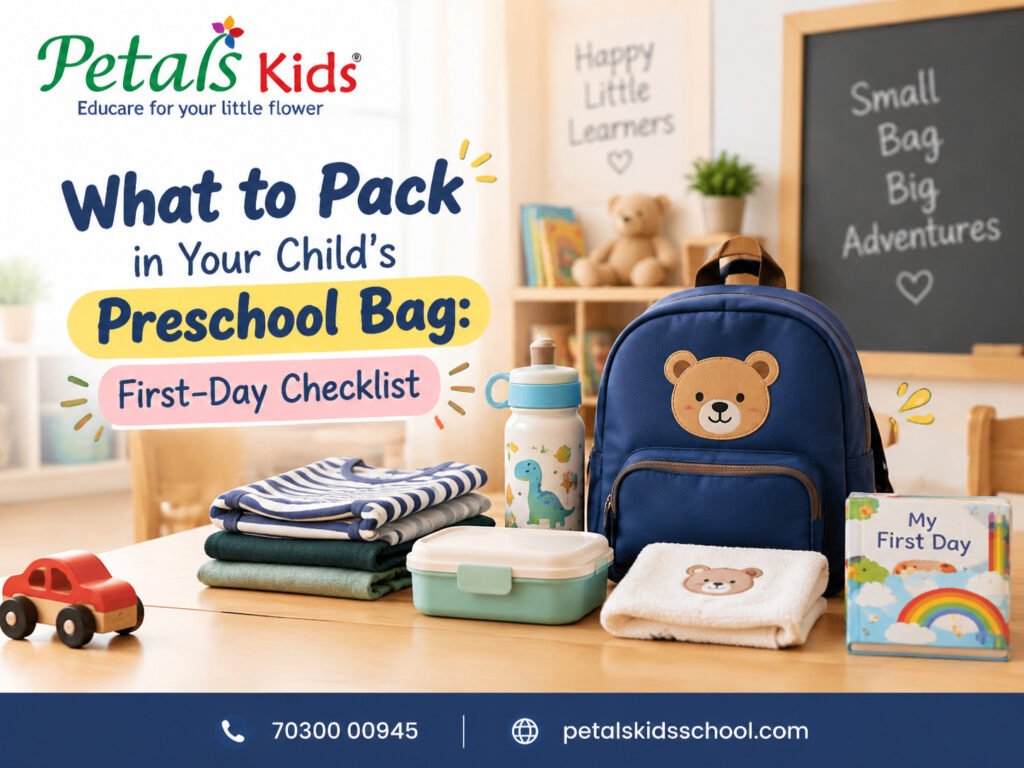
Every preschool has its own list, but these items cover almost every situation a young child faces during a half day or full day session.
- A labelled water bottle, easy for small hands to open and close on their own
- One to two spare sets of clothes, including inner wear and socks, packed in a separate pouch
- A small towel or handkerchief for spills, sweat or a runny nose
- A pack of wet wipes and tissues
- A lunch box with food the child already eats comfortably at home, avoiding anything new on day one
- A comfort item, such as a small soft toy or a piece of cloth the child sleeps with, if the school allows it
- A diary or communication notebook, if the school uses one to update parents
- Indoor shoes or extra socks, if the classroom has a no-outdoor-shoes rule
- A raincoat, sweater or cap depending on the season
- A bag labelled clearly with the child’s name and the same label repeated on the water bottle and lunch box
Keep the bag itself light and simple to open. A child who struggles with buckles or zips at a stressful moment often becomes more upset than they would over the actual item they are trying to reach.
Why What You Pack Matters More Than You Think
- It builds a sense of security. A familiar water bottle, cloth or snack gives a young child something predictable in a new environment.
- It reduces separation anxiety. Children settle faster when small comforts from home travel with them, even for the first week or two.
- It helps the teacher respond quickly. A clearly labelled bag with the right items means a spill, a wet uniform or hunger can be handled within minutes, not after a phone call home.
- It teaches early independence. A child who helps choose and pack a few items starts learning responsibility before they can even tie their own shoelaces.
- It avoids last minute morning stress. A checklist prepared the night before removes one more thing to rush through on a morning that is already emotional for most families.
Preschool bag checklist by Age Group
| Aspect | Playgroup (1.5 to 3 years) | Nursery to Senior KG (3 to 6 years) |
|---|---|---|
| Spare clothes | Two full sets, including inner wear | One set is usually enough |
| Comfort item | Often necessary for settling in | Optional, based on the child |
| Lunch | Simple finger foods, pre-cut and easy to chew | Wider variety, child can self-feed with a spoon |
| Labelling | Every single item, including socks | Bag, bottle and lunch box at minimum |
| Bag size | Small and light, minimal buckles | Slightly bigger, can include a diary or book |
What Early Childhood Experts Recommend
Guidance referenced in NCERT’s Early Childhood Care and Education framework points to predictable routines and familiar objects as important tools for helping a young child settle into a new setting. Industry estimates from early years research also suggest that children who arrive with a consistent, well organised bag and a calm morning routine tend to settle into a new classroom faster than children whose first days are rushed or disorganised, though every child adjusts at their own pace. Parents can also explore our early learning programmes to understand how we support children during their early years.
Signs Your Packing Routine Is Working
- Your child stops asking to check the bag repeatedly through the evening before school
- Your child can point out or name their own water bottle and lunch box
- The teacher reports that the packed items were actually used during the day
- There are no complaints about missing spare clothes or a forgotten water bottle after the first week
- Your child starts wanting to help zip the bag or choose the next day’s snack
How Petals Kids Supports a Smooth First Day
At Petals Kids Preschool in Pune the first day is treated as part of the curriculum, not just a logistics exercise. Teachers are trained to check each child’s bag gently on arrival, note what has been packed and use that information to settle the child faster, whether that means offering the comfort item early or knowing exactly which snack a fussy eater prefers. This approach is part of the same six-domain Outcome-Based Activity Curriculum used across every Petals Kids branch, covering physical, cognitive, language, social-emotional, creative and personal independence growth from the very first day a child walks in.
Parents are also given a simple, branch-specific packing guide before the first day, so nothing is left to guesswork.
How Parents Can Prepare at Home Before Day One
- Practise opening and closing the water bottle and lunch box together at home, so it is not a new skill learned under pressure
- Let your child choose one or two items to pack themselves, even something as small as picking which snack goes in
- Practise a simplified version of the school routine, including toilet visits, a few days before the actual start
- Talk about the school day in a positive, matter-of-fact way, without over-explaining or making it sound like a big event
- Keep the morning routine on day one as close as possible to a normal school day, rather than rushing through an unfamiliar sequence
Frequently Asked Questions
What should I avoid packing in my child’s preschool bag?
Avoid packing sharp objects, small loose toys that can be a choking hazard, glass containers, or food that needs reheating. Most schools also discourage electronic toys or gadgets that can distract the child or other children during class.
Should I pack a favourite toy on the first day?
Yes, if the school allows it. A small, familiar comfort item often helps more on the first few days than any new item you might buy specially for the occasion.
How many spare clothes should I really pack?
For a child in playgroup or nursery, two full sets including inner wear is a safe amount. For an older preschooler in senior KG, one spare set is usually enough unless the child is prone to spills or accidents.
My school provides lunch. Do I still need to pack food?
Check with the school first, but it is still worth packing a small labelled water bottle and a light snack, since some children eat on a different schedule than the rest of the class in the first week.
What is a reliable way to label preschool items?
Use a permanent marker or stick-on name labels on the bag, water bottle, lunch box and any loose items like a towel or spare clothes pouch. Avoid labels that can peel off after one wash.
What if my child refuses to carry the bag on the first day?
This is common and usually settles within a few days. Let a teacher or parent carry it for the first day rather than turning it into a struggle, and gently encourage your child to carry it themselves once they feel more settled.
Getting Ready for a Confident First Day
Working through a proper preschool bag checklist will not remove every first-day nerve, but it removes a long list of small, avoidable problems that can make an already emotional morning harder than it needs to be. Focus on familiar, easy to use items, involve your child in the packing process and keep the morning routine as calm and predictable as you can.
Parents are welcome to reach out to their nearest Petals Kids branch for a printed, branch-specific preschool bag checklist before their child’s start date.

Archana Khosla is a Doctor (in Ayurvedic Medicine) by profession and an Educationist by passion. She is the favorite of every child at Petals Kids, and is patient by nature. She’s a Trained Montessori Teacher, Diploma in “Daycare Management, Certified “Parenting Coach” & “Play Therapist”, Life-time member of “Early Childhood Association” (ECA).
Archana has been in the Child Care and Education field for more than 20 years. In line with Petals vision to achieve excellence in providing progressive education & care i.e., “Educate for your little flower”. She strongly believes in continuous enhancement of her skills, as well of her team.
Dr. Archana Khosla
Archana Khosla is a Doctor (in Ayurvedic Medicine) by profession and an Educationist by passion. She is the favorite of every child at Petals Kids, and is patient by nature. She's a Trained Montessori Teacher, Diploma in "Daycare Management, Certified "Parenting Coach" & "Play Therapist", Life-time member of "Early Childhood Association" (ECA).
Archana has been in the Child Care and Education field for more than 20 years. In line with Petals vision to achieve excellence in providing progressive education & care i.e., "Educate for your little flower". She strongly believes in continuous enhancement of her skills, as well of her team.