

Table of contents
- Why Is a Preschool Tour Important?
- 10 Essential Questions to Ask on a Preschool Tour
- 1. What Teaching Method and Curriculum Does the Preschool Follow?
- 2. Are the Teachers Qualified and Trained to Work With Young Children?
- 3. How Does the Preschool Ensure Children’s Safety?
- 4. What Is the Teacher-to-Child Ratio?
- 5. What Does a Typical Day at Preschool Look Like?
- 6. How Does the Preschool Help Children Adjust to a New Environment?
- 7. How Does the School Communicate With Parents?
- 8. How Does the Preschool Handle Discipline and Conflicts Between Children?
- 9. What Are the Fees, Timings, and Other Policies?
- 10. How Does the Preschool Track a Child’s Development and Learning Progress?
- What Should Parents Observe During a Preschool Tour?
- How Can You Tell if a Preschool Is Right for Your Child?
- Conclusion
Choosing a preschool is an important decision for every parent. You want your child to feel safe, make friends, enjoy learning, and become more independent. But when you visit a preschool, how can you tell whether it is the right place for your child?
A school tour gives you the opportunity to look beyond colourful classrooms and attractive play areas. You can observe how teachers interact with children, understand the daily routine, check safety arrangements, and learn how the school supports early childhood development.
Before making a decision, prepare a list of questions to ask on a preschool tour. The answers can help you compare schools, understand what your child will experience each day, and choose a setting that fits your child’s needs and your family’s routine.
Why Is a Preschool Tour Important?
A preschool tour helps parents understand how a school operates in everyday situations. A brochure may describe the curriculum and facilities, but a visit allows you to see the classrooms, play areas, learning materials, and interactions between teachers and children.
During your visit, notice whether children seem engaged, whether teachers speak patiently, and whether the environment looks clean and organised. Ask for clear answers about safety, learning activities, communication, and fees before enrolling your child.
If you are comparing preschool and daycare programmes at Petals Kids, use the same checklist for each branch you visit. This makes it easier to compare what matters instead of deciding based only on first impressions.
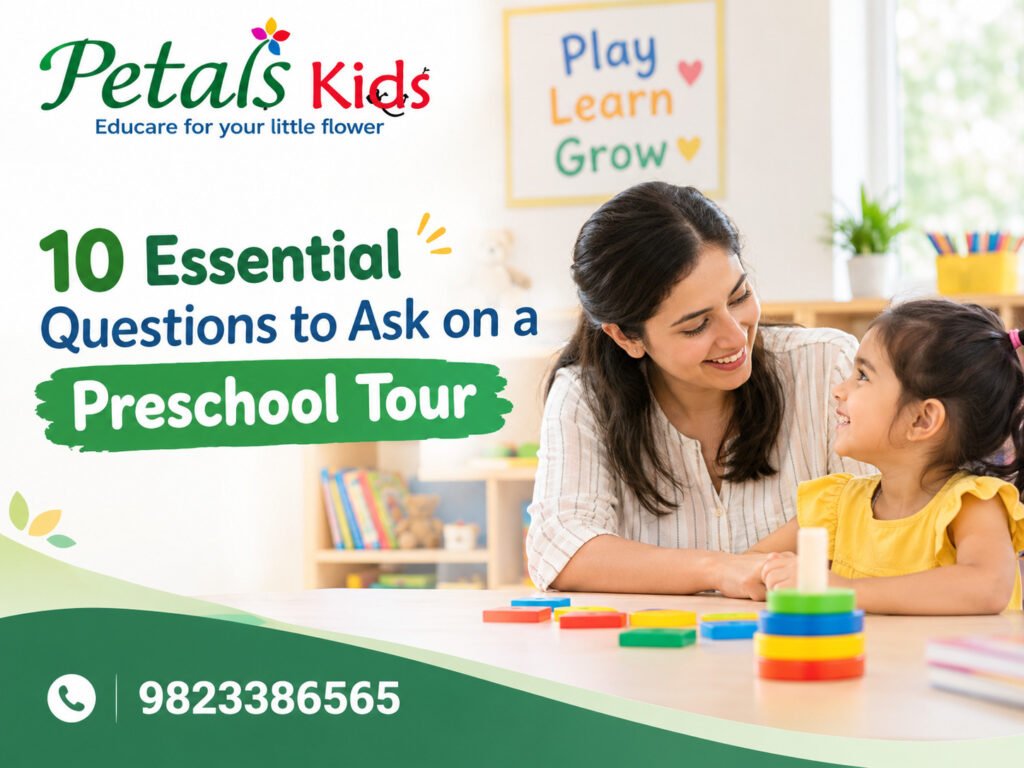
10 Essential Questions to Ask on a Preschool Tour
1. What Teaching Method and Curriculum Does the Preschool Follow?
The first question to ask is how the preschool helps children learn. Early childhood education should support more than letters, numbers, and writing. Young children also need opportunities to explore, communicate, create, solve simple problems, and interact with others.
Ask the school how its curriculum supports your child’s age and stage of development.
Questions to ask:
- Does the school use play-based learning, structured activities, or a combination of both?
- What skills will my child develop during the academic year?
- How are stories, music, art, puzzles, and hands-on activities included?
- How do teachers understand and track each child’s progress?
What to look for: Children should have opportunities to learn through age-appropriate activities, play, conversation, and exploration. Ask for examples of a typical classroom activity rather than relying only on a curriculum presentation.
2. Are the Teachers Qualified and Trained to Work With Young Children?
Teachers have an important role in shaping a child’s early learning experience. Their communication, patience, and understanding of child development can influence how comfortable children feel at school.
During your tour, ask about the teachers’ qualifications, early childhood education training, experience, and opportunities for professional development.
Questions to ask:
- What qualifications and training do the teachers have?
- How are new teachers prepared for classroom responsibilities?
- Do teachers receive regular training?
- Who supervises the classroom and supports children who need additional attention?
What to look for: Observe how teachers speak to children. Do they listen when a child asks a question? Do they encourage children to try activities independently? A calm, respectful approach is an important sign to look for.
3. How Does the Preschool Ensure Children’s Safety?
Safety should be one of the first things parents assess during a preschool visit. Children need an environment where they can explore while adults maintain appropriate supervision.
Ask the school to explain its safety procedures and, where possible, show you the arrangements in place.
Questions to ask:
- How is entry and exit managed?
- Who is authorised to collect a child?
- Are classrooms and play areas supervised?
- What happens if a child becomes unwell or gets injured?
- Are emergency contacts and evacuation procedures maintained?
What to look for: Check whether entrances are controlled, furniture and toys are in good condition, electrical points are protected where necessary, and play equipment is suitable for young children. Ask about staff verification, first-aid arrangements, emergency drills, and visitor policies.
Do not hesitate to ask for details about the school’s written safety procedures. A clear explanation is more useful than a general assurance that the school is safe.
4. What Is the Teacher-to-Child Ratio?
The teacher-to-child ratio refers to the number of children supervised by each teacher or caregiver. It can affect how much individual attention children receive, particularly during meals, play, classroom activities, and transitions.
Questions to ask:
- How many children are there in each classroom?
- How many teachers and assistants are present during the day?
- Does the ratio change during meals, outdoor play, or rest time?
- Who supervises children when a teacher is absent?
What to look for: Ask for the actual number of children and adults in your child’s proposed classroom. Consider the age of the children, the room layout, and the nature of the activities. A small group may make individual attention easier, but the ratio alone does not determine the quality of care.
5. What Does a Typical Day at Preschool Look Like?
A predictable daily routine can help young children feel comfortable and understand what happens next. However, the schedule should also leave room for play, movement, rest, and individual needs.
Ask the preschool to explain a typical day from arrival to departure.
Questions to ask:
- How much time is spent on free play and guided activities?
- Are outdoor play, stories, music, and creative activities included?
- How are snack time, meals, and rest breaks managed?
- What happens if a child needs extra time to settle into an activity?
What to look for: The day should offer a suitable balance of active and quiet activities, individual exploration, and group interaction. Ask whether you can see a sample timetable or observe a regular classroom session during your visit.
6. How Does the Preschool Help Children Adjust to a New Environment?
Starting preschool can be an emotional change for both children and parents. Some children settle quickly, while others need time to become comfortable with unfamiliar adults, new routines, and separation from their families.
Ask how the school supports children during their first few days and weeks.
Questions to ask:
- Is there a gradual settling-in process?
- How do teachers respond when a child cries at drop-off?
- Can parents share information about the child’s routines and comfort needs?
- How are changes in the child’s behaviour or adjustment communicated to parents?
What to look for: Teachers should respond with patience and reassurance rather than shame or punishment. Ask how the school helps children build familiarity with the classroom, develop relationships, and gradually participate in activities.
Remember that children adjust at different speeds. A preschool should be willing to discuss an individual child’s needs instead of expecting every child to settle in the same way.
7. How Does the School Communicate With Parents?
Parents need to know how their child is settling in, participating in activities, and managing everyday routines. Clear communication also helps families and teachers work together when a child needs additional support.
Questions to ask:
- How often do teachers share updates about a child’s day?
- Are parents informed about learning progress and social development?
- Whom should I contact if I have a concern?
- How are accidents, health concerns, or changes in behaviour communicated?
What to look for: Ask whether updates are provided through meetings, written reports, phone calls, or a parent communication system. Understand how quickly urgent concerns are shared and whether parents can arrange a discussion with the teacher.
You should feel comfortable asking questions and discussing your child’s needs.
8. How Does the Preschool Handle Discipline and Conflicts Between Children?
Young children are still learning to share, take turns, express feelings, and solve disagreements. Conflicts can occur during play, and teachers play an important role in helping children understand their emotions and behaviour.
Ask the school how it responds when children argue, refuse to participate, or have difficulty following instructions.
Questions to ask:
- How do teachers handle hitting, pushing, or grabbing toys?
- How are children encouraged to share and take turns?
- What happens when a child repeatedly struggles with a classroom rule?
- How are parents involved when behavioural concerns arise?
What to look for: Teachers should use age-appropriate guidance, clear boundaries, and calm explanations. Ask whether the school avoids humiliating, threatening, or physically punishing children.
The goal should be to help children learn safer ways to express their feelings and interact with others.
9. What Are the Fees, Timings, and Other Policies?
A preschool may suit your child’s learning needs but still be difficult for your family if the timings, location, or fees do not fit your routine.
Before enrolling, understand the complete cost and the practical arrangements involved.
Questions to ask:
- What is included in the admission fee and tuition fee?
- Are meals, transport, activities, uniforms, or learning materials charged separately?
- What are the school hours and holiday schedule?
- Is daycare available if parents need extended care?
- What are the late-pickup, absence, withdrawal, and refund policies?
What to look for: Request a written fee breakdown and copies of the relevant policies. Confirm the actual timings for the branch and programme you are considering. If you are a working parent, check whether the available schedule fits your work hours and travel time.
Understanding these details in advance can help avoid unexpected costs and scheduling difficulties later.
10. How Does the Preschool Track a Child’s Development and Learning Progress?
Preschool is not only about preparing children for primary school. It is also a time when they develop language, social interaction, coordination, independence, creativity, and early problem-solving skills.
Ask how teachers observe progress and identify areas where a child may need additional support.
Questions to ask:
- How do teachers monitor children’s progress?
- Will parents receive regular progress updates?
- How are children supported when they learn at different speeds?
- How does the school encourage independence and confidence?
- What happens if a teacher notices a possible developmental concern?
What to look for: The school should be able to explain what it observes, how it shares progress with parents, and how it adapts activities to children’s needs. Young children develop at different rates, so assessment should help guide learning rather than create unnecessary pressure or comparisons.
Parents can also explore the school’s approach to early learning and child development to understand its educational philosophy and the learning areas it aims to support.
What Should Parents Observe During a Preschool Tour?
Asking questions is important, but observing the environment can tell you just as much. Use this quick checklist while walking through the school.
- Classrooms, washrooms, and play areas appear clean and well maintained.
- Toys and learning materials are age-appropriate and in usable condition.
- Children have opportunities for play, movement, and creative activities.
- Teachers speak respectfully and respond to children’s needs.
- Children are supervised during classroom activities and transitions.
- Outdoor play areas and equipment are suitable for the children’s ages.
- The school can explain its safety and emergency procedures.
- Staff can clearly describe the daily routine and learning approach.
- Parents know whom to approach with questions or concerns.
- The school explains fees, timings, and policies clearly.
No single feature tells you everything about a preschool. Consider your observations alongside the answers you receive, the needs of your child, and the information available about the school.
How Can You Tell if a Preschool Is Right for Your Child?
The right preschool should meet your child’s developmental needs while fitting your family’s practical requirements. Instead of choosing based only on decorations, advertisements, or recommendations, compare a few important factors.
Safety and supervision: Are the arrangements clear, appropriate, and consistently followed?
Learning environment: Do children have opportunities to explore, play, communicate, and build everyday skills?
Teacher interaction: Do adults respond patiently and respectfully to children?
Individual attention: Can the school explain how it supports children with different personalities, interests, and learning speeds?
Family communication: Are parents encouraged to share concerns and receive meaningful updates?
Practical fit: Do the location, timings, fees, and available services work for your family?
You can use these points to compare preschools on the same basis. A school that answers your questions clearly and allows you to understand its daily practices gives you more useful information for making a decision.
Frequently Asked Questions About Choosing a Preschool
1. What should I ask when visiting a preschool for the first time?
Ask about the curriculum, teacher qualifications, child safety, teacher-to-child ratio, daily routine, settling-in process, parent communication, discipline, fees, and progress assessments. Also observe how teachers interact with children and whether the environment is clean and suitable for their age.
2. What is the most important thing to look for in a preschool?
Safety, caring teacher-child interactions, and an age-appropriate learning environment are important starting points. Parents should also consider the child’s individual needs, the school’s communication practices, and whether its timings and fees fit the family.
3. Should I visit a preschool before enrolling my child?
Yes. An in-person visit helps you see the classrooms, play spaces, learning materials, and daily arrangements. It also gives you an opportunity to ask questions and understand how the school operates before making a decision.
4. How do I know if a preschool is safe?
Ask about supervised entry and exit, authorised collection procedures, staff verification, emergency plans, first-aid arrangements, illness policies, and classroom supervision. Look around the premises for potential hazards and ask the school to explain its written safety procedures.
5. What is a good teacher-to-child ratio for preschool?
There is no single ratio that should be applied to every preschool age group and setting. The appropriate number depends on children’s ages, applicable local requirements, the classroom environment, and the programme. Ask how many children and adults are present in your child’s actual classroom and how supervision is maintained throughout the day.
6. How long does it take a child to settle into preschool?
It varies. Some children become comfortable within a few days, while others need several weeks or longer. A predictable routine, supportive teachers, communication with parents, and a suitable settling-in plan can help children adjust.
7. What is the difference between preschool and daycare?
Preschool generally focuses on early learning, social development, play, and preparation for the next stage of education. Daycare provides supervised care for children while parents work or manage other responsibilities. Some centres provide both services, but their age groups, timings, routines, and activities may differ.
8. Should I choose a preschool close to home or work?
Consider travel time, your daily schedule, emergency access, and who will handle drop-off and collection. A nearby preschool may make daily routines easier, while a centre closer to work may suit some families. The best choice depends on your family’s circumstances and the child’s needs.
9. What documents should I ask about before preschool admission?
Ask the school for its admission checklist. Depending on the centre, you may need a birth certificate or age proof, parent identification and contact details, photographs, emergency contacts, and relevant medical or allergy information. Confirm the exact requirements directly with the school.
10. When should I start visiting preschools for admission?
Start researching a few months before your preferred joining date, especially if you have a particular branch or programme in mind. Ask about admission dates, available places, age eligibility, fees, and the possibility of a school tour.
Conclusion
Choosing a preschool becomes easier when you know what to ask and what to observe. A useful school visit should leave you with a clear understanding of the learning approach, safety procedures, teacher interactions, daily routine, parent communication, and costs.
Take your checklist to every visit, compare the answers, and consider how your child might feel in each environment. The goal is not simply to find an attractive classroom, but to choose a setting where your child can feel secure, explore new ideas, build relationships, and develop at their own pace.
If you are considering a preschool for your child, you can get in touch with Petals Kids to discuss branch visits, available programmes, timings, and admission details. Speaking with the relevant branch can help you clarify practical questions before making your final decision.

Archana Khosla is a Doctor (in Ayurvedic Medicine) by profession and an Educationist by passion. She is the favorite of every child at Petals Kids, and is patient by nature. She’s a Trained Montessori Teacher, Diploma in “Daycare Management, Certified “Parenting Coach” & “Play Therapist”, Life-time member of “Early Childhood Association” (ECA).
Archana has been in the Child Care and Education field for more than 20 years. In line with Petals vision to achieve excellence in providing progressive education & care i.e., “Educate for your little flower”. She strongly believes in continuous enhancement of her skills, as well of her team.
Dr. Archana Khosla
Archana Khosla is a Doctor (in Ayurvedic Medicine) by profession and an Educationist by passion. She is the favorite of every child at Petals Kids, and is patient by nature. She's a Trained Montessori Teacher, Diploma in "Daycare Management, Certified "Parenting Coach" & "Play Therapist", Life-time member of "Early Childhood Association" (ECA).
Archana has been in the Child Care and Education field for more than 20 years. In line with Petals vision to achieve excellence in providing progressive education & care i.e., "Educate for your little flower". She strongly believes in continuous enhancement of her skills, as well of her team.