

Table of contents
- Why Is Attention and Concentration Important for Preschoolers?
- 10 Activities to Improve Attention and Concentration in Preschoolers
- How Long Can Preschoolers Concentrate?
- How Can Parents Improve Concentration at Home?
- How Preschool Activities Support Attention Development
- When Should Parents Be Concerned About Poor Concentration?
- Frequently Asked Questions
- Conclusion
The best activities to improve attention and concentration in preschoolers include puzzles, memory games, sorting activities, storytelling, building blocks, Simon Says, and outdoor obstacle courses. These activities help children aged 3–5 practice focusing, remembering instructions, and completing simple tasks. Parents can begin with 5–10 minutes of enjoyable play, adjusting the duration to their child’s interest and abilities. Consistent practice, movement breaks, and a distraction-free environment can help children gradually develop attention skills. At Petals Kids, play-based learning is an important part of supporting children’s early development and learning experiences.
Why Is Attention and Concentration Important for Preschoolers?
Attention helps children listen to instructions, participate in activities, solve problems, and complete everyday tasks. These skills also support early literacy, numeracy, and social interactions.
However, preschoolers naturally have shorter and more variable attention spans than older children. A child who moves frequently or changes activities is not necessarily experiencing a concentration problem.
At this age, learning through play is usually more appropriate than expecting children to sit quietly for long periods.
10 Activities to Improve Attention and Concentration in Preschoolers
1. Jigsaw Puzzles
Puzzles encourage children to observe shapes, recognize patterns, and work towards completing a task.
Try this at home: Start with a 4–6-piece puzzle and gradually introduce more pieces as your child becomes comfortable. Allow them to solve it independently while offering gentle hints when needed.
2. Memory Matching Games
Memory games encourage children to pay attention to details and remember where objects are placed.
Place three pairs of picture cards face down. Ask your child to turn over two cards and find matching pictures.
Begin with fewer cards and increase the number gradually.
3. Sorting Colors and Shapes
Sorting activities encourage children to notice differences, follow instructions, and focus on one task.
Provide coloured blocks or large buttons and ask your child to group them by colour, size, or shape.
For an additional challenge, change the sorting rule halfway through the game.
4. Simon Says
Simon Says is a simple listening game that encourages attention and self-control.
Give instructions such as “Simon says touch your nose” or “Simon says clap twice.”
Children must listen carefully and respond only when the instruction begins with “Simon says.”
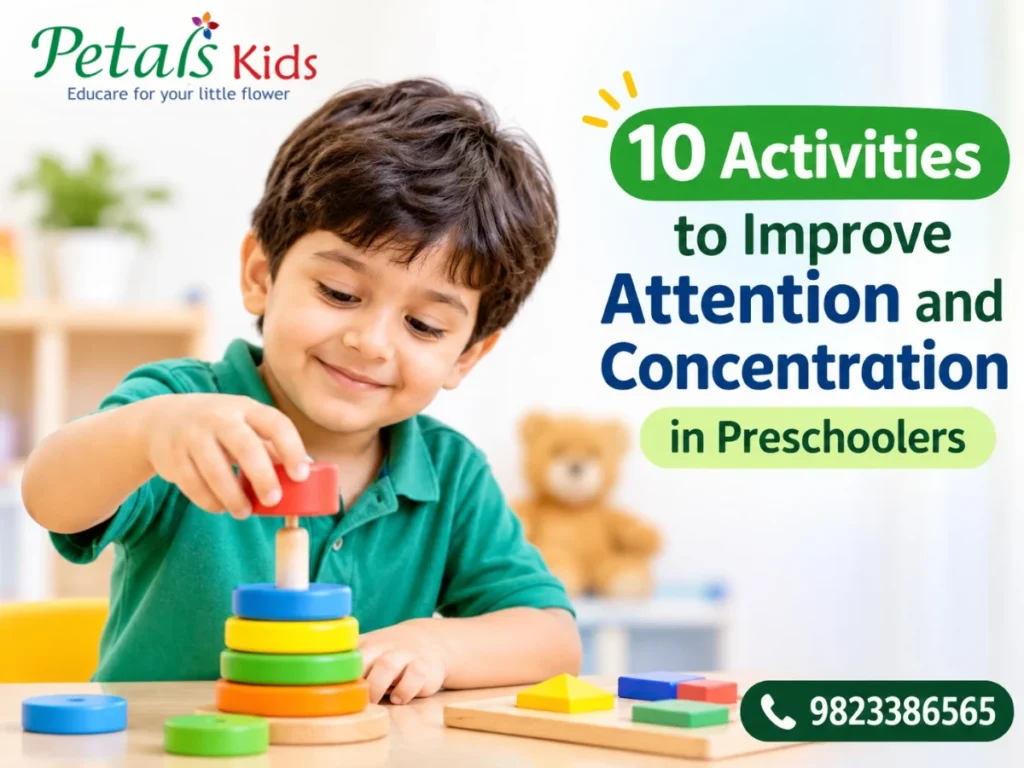
5. Building Blocks and Construction Play
Building towers and simple structures can encourage concentration, planning, and problem-solving.
Ask your child to recreate a small structure using blocks. Start with three or four blocks and gradually introduce more complex designs.
Avoid correcting every mistake. Allow children to experiment with their own solutions.
6. Storytelling and Picture Books
Reading together encourages children to follow a sequence of events, listen carefully, and remember details.
After reading a short story, ask:
- What happened first?
- Who was your favorite character?
- What do you think happens next?
Keep questions conversational rather than turning reading into a test.
7. Spot the Difference
Picture comparison games encourage visual attention and observation.
Show your child two similar illustrations with a few differences. Ask them to identify what has changed.
For younger preschoolers, start with pictures containing two or three obvious differences.
8. Follow the Leader
This movement-based activity combines attention, memory, and physical coordination.
Walk around the room while performing simple actions such as clapping, jumping, or turning around. Ask your child to copy the movements.
Gradually introduce sequences of two or three actions.
9. Playdough and Creative Activities
Playdough, drawing, and age-appropriate craft activities allow children to concentrate while using their imagination.
Encourage your child to create a particular shape, animal, or object, but allow flexibility in how they complete it.
The objective is engagement, not creating a perfect finished product.
10. Simple Obstacle Courses
Create an indoor obstacle course using cushions, floor markings, and safe household objects.
Give instructions such as “Walk around the cushion, step over the line, and place the ball in the basket.”
This activity encourages children to remember instructions while controlling their movements.
How Long Can Preschoolers Concentrate?
There is no fixed attention-span rule that applies to every child. Concentration depends on age, interest, tiredness, environment, and the activity itself.
| Age | Suggested Starting Activity Duration |
|---|---|
| 3 years | 5 minutes |
| 4 years | 5–10 minutes |
| 5 years | 10–15 minutes |
These are flexible starting points for guided activities, not developmental benchmarks. Some children can remain engaged in favorite activities much longer.
Parents exploring a play-based learning environment can learn more about the programmes and daily activities available at our preschool.
How Can Parents Improve Concentration at Home?
Small changes in everyday routines can make focused play easier.
Create a calm activity space: Reduce unnecessary background noise, television, and distracting toys.
Offer one activity at a time: Too many choices can make it difficult for younger children to remain engaged.
Include movement breaks: Outdoor play, stretching, or dancing can help children return to quieter activities.
Maintain consistent routines: Adequate sleep, meals, physical activity, and predictable schedules support children’s general wellbeing and readiness to learn.
Appreciate effort: Instead of focusing only on correct answers, recognize when your child makes an effort or tries again.
How Preschool Activities Support Attention Development
Preschool classrooms can provide opportunities to practice attention through group storytelling, creative play, matching games, music, and guided activities.
A balanced early learning environment allows children to move between active play, quiet activities, and social interaction rather than expecting continuous seated concentration.
Parents interested in understanding how Petals Kids School supports early childhood learning through play-based activities can learn more about our school, its educational philosophy, and the nurturing learning environment designed for young children.
When Should Parents Be Concerned About Poor Concentration?
Occasional distraction is common during the preschool years. However, parents may consider speaking with a pediatrician when attention-related difficulties are persistent, occur across different settings, and significantly affect everyday activities.
Concerns may include unusual difficulty following age-appropriate instructions, participating in play, or managing daily routines.
Hearing difficulties, sleep problems, language delays, and other developmental factors can also affect a child’s apparent attention.
Difficulty concentrating alone does not establish ADHD or another developmental condition.
Frequently Asked Questions
1. What is the best activity to improve concentration in a 3-year-old?
Simple puzzles, matching games, building blocks, and interactive picture books are useful starting points. Choose activities that interest your child.
2. Can screen time affect a preschooler’s attention span?
Excessive or inappropriate screen use may be associated with attention, sleep, and behavioral difficulties. Priorities interactive play, physical activity, quality content, and family interaction.
3. How can I improve my 4-year-old’s listening skills?
Try Simon Says, storytelling, and short instruction-following games. Give clear directions and gradually increase their complexity.
4. Should preschoolers practice concentration activities every day?
Regular opportunities for enjoyable, child-led play are beneficial. Formal concentration exercises or rigid daily targets are unnecessary.
Conclusion
Improving attention and concentration in preschoolers does not require expensive learning materials or strict study schedules. Simple activities such as puzzles, storytelling, sorting games, and building blocks provide valuable opportunities to practice focus naturally.
The goal is to make learning enjoyable while respecting each child’s developmental pace.
If you would like to learn more about how structured and play-based activities support your child’s learning and development at Petals Kids School, you can get in touch with our team to explore our preschool programmes and learning environment.

Archana Khosla is a Doctor (in Ayurvedic Medicine) by profession and an Educationist by passion. She is the favorite of every child at Petals Kids, and is patient by nature. She’s a Trained Montessori Teacher, Diploma in “Daycare Management, Certified “Parenting Coach” & “Play Therapist”, Life-time member of “Early Childhood Association” (ECA).
Archana has been in the Child Care and Education field for more than 20 years. In line with Petals vision to achieve excellence in providing progressive education & care i.e., “Educate for your little flower”. She strongly believes in continuous enhancement of her skills, as well of her team.
Dr. Archana Khosla
Archana Khosla is a Doctor (in Ayurvedic Medicine) by profession and an Educationist by passion. She is the favorite of every child at Petals Kids, and is patient by nature. She's a Trained Montessori Teacher, Diploma in "Daycare Management, Certified "Parenting Coach" & "Play Therapist", Life-time member of "Early Childhood Association" (ECA).
Archana has been in the Child Care and Education field for more than 20 years. In line with Petals vision to achieve excellence in providing progressive education & care i.e., "Educate for your little flower". She strongly believes in continuous enhancement of her skills, as well of her team.