

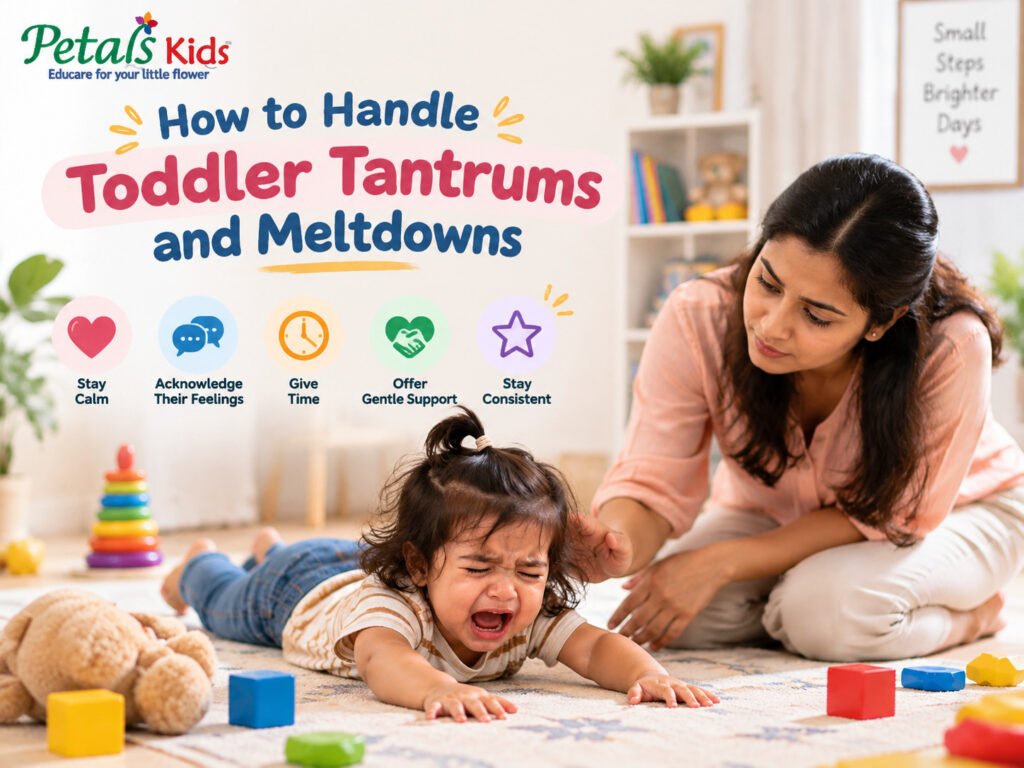
Table of contents
Key Takeaways
- Tantrums are normal between ages 1 and 3 and reflect a toddler’s still-developing language and self-control, not a parenting failure.
- Tantrums and meltdowns are different. A tantrum is usually about wanting something; a meltdown is an overwhelm response that can’t be talked or distracted out of.
- Hunger, tiredness, overstimulation, and frustration are the most common tantrum triggers.
- Consistency reduces tantrum frequency more than any single in-the-moment tactic.
- Talk to a pediatrician if a toddler hurts themselves or others, holds their breath and faints, or if tantrums worsen after age four.
Toddlers can go from calm to crying on the floor in seconds, and it can happen anywhere – the living room, the car, or the middle of a grocery store aisle. Most parents already recognize a tantrum when they see one, but understanding why they happen, what’s typical at each age, and which responses actually help can make these moments far less stressful for both toddler and parent. This guide walks through what causes tantrums, how they tend to show up at different ages, and practical, day-to-day ways to handle them calmly.
What Counts as a Tantrum vs. a Meltdown
A tantrum usually happens when a toddler wants something and cannot have it, whether that’s a toy, a snack, or more time doing something fun. It often includes crying, yelling, or dropping to the floor, and a child having a tantrum is frequently still aware of who is watching. A meltdown looks similar on the outside but comes from a different place: it is an overwhelm response, often triggered by too much noise, too many transitions, or built-up tiredness, and a toddler in a meltdown usually can’t be reasoned with or distracted the way a tantrum sometimes allows. Knowing which one you’re dealing with changes how you respond.
Why Toddlers Have Tantrums
Toddlers are still developing the language to say what they want and the self-control to wait for it, which is a large part of why tantrums are considered a normal, expected stage of early childhood. Pediatric guidance from the American Academy of Pediatrics notes that almost all children go through tantrums between the ages of one and three as they learn self-control. This stage of development means big feelings often arrive faster than the words or patience needed to manage them, and tantrums are one of the main ways that mismatch shows up. Most children also see tantrum frequency and intensity decrease with age, which is part of why occasional outbursts are treated as a passing stage rather than a lasting problem.
Common Triggers
- Hunger or a missed meal or snack
- Tiredness, especially around nap time or later in the day
- Overstimulation from noise, crowds, or too many activities at once
- Frustration at not being understood or not being able to do something independently
- Testing limits as independence grows
Tantrums by Age: What’s Typical
These ranges describe common patterns, not fixed rules – every toddler’s timeline looks a little different.
| Age | What’s Typical | What to Keep in Mind |
|---|---|---|
| 12–18 months | Short, frustration-driven outbursts | Vocabulary is still very limited, so crying is often the main way to communicate |
| 18–24 months | More frequent tantrums, sometimes with hitting or throwing | Independence and limit-testing increase sharply during this stage |
| 2 to 4 years | Longer, more intense tantrums, including in public | Emotional regulation is still developing; a consistent response matters more than any single tactic |
| 4 years and older | Tantrums should generally be tapering off | Frequent or escalating tantrums past this age are worth mentioning to your pediatrician |
What This Guidance Means for Parents
Pediatric thinking on tantrums has moved away from treating every outburst as a discipline problem and toward asking a broader question: what is this tantrum telling me, and what does my child need right now – food, sleep, attention, or simply time to calm down? In practice, this means the trigger, the setting, and how your toddler responds to comfort often matter more than the tantrum’s length alone. A toddler melting down from exhaustion at the end of a long day calls for a different response than a toddler testing a limit at snack time, even though both can look identical in the moment. This same thinking shapes how our teachers approach big feelings in the classroom at Petals Kids.
Signs a Tantrum May Need Extra Attention
- Your toddler is hurting themselves or others during outbursts
- Your toddler holds their breath and faints during a tantrum
- Tantrums seem to be getting worse rather than better after age four
- Your toddler struggles to use words to express feelings compared with peers the same age
- Outbursts happen very frequently or last an unusually long time
If you notice any of these patterns, it’s worth mentioning to your pediatrician, who can rule out other causes and offer guidance suited to your child.
How Petals Kids Supports Children Through Big Emotions
At Petals Kids, our classrooms are built around consistent routines, clear expectations, and teachers trained to help children name what they’re feeling instead of simply reacting to it. When a child is overwhelmed, our teachers use calm, simple language and a quiet space within the classroom to help them settle before rejoining group activities like our music and dance sessions. This same consistency – knowing what comes next and feeling heard when upset – is something families can build on at home, and our teachers are always happy to share what’s working well for your child during the day.
Tips for Handling Tantrums at Home
- Notice and praise calm moments, not just the outbursts
- Offer small choices during a tantrum (Do you want the red cup or the blue one?) instead of yes-or-no questions
- Distract or redirect before a tantrum fully escalates – a new activity, a change of room, or something silly can help
- Keep your rules consistent, even mid-tantrum, so limits don’t feel negotiable
- Plan around known triggers – carry a snack, protect nap time, and build in downtime after busy outings
- Treat hitting, biting, and throwing as non-negotiable, regardless of what triggered the tantrum
- Stay calm yourself; toddlers often take their emotional cue from the adult in the room
For a related read, see our guide on screen time habits for toddlers.
Frequently Asked Questions
At what age do tantrums usually peak?
Tantrums are most common between ages one and three, as toddlers are still developing language and self-control. Most children see them ease up gradually after this stage as communication and patience improve.
Is it okay to give in during a tantrum?
Occasionally softening a rule to keep the peace happens to most parents, but giving in regularly can make tantrums more frequent, since the child learns that they work. Consistency, even when it’s harder in the moment, tends to reduce tantrums over time.
Should I ignore my toddler during a tantrum?
Ignoring the tantrum itself, rather than the child, is a common and often effective approach for outbursts driven by wanting something they can’t have. This is different from ignoring the child altogether, and behaviors like hitting or biting should never be ignored.
Are meltdowns different from tantrums?
Yes. A tantrum is often connected to wanting something, while a meltdown is more of an overwhelm response that a toddler usually can’t be distracted or reasoned out of. Both are normal, but they call for slightly different responses.
When should I talk to a pediatrician about tantrums?
It’s worth mentioning to your pediatrician if your toddler is hurting themselves or others, holds their breath until they faint, if tantrums seem to worsen after age four, or if your child struggles with words compared with same-age peers.
Can a daily routine really reduce tantrums?
Yes. A predictable routine around meals, naps, and transitions removes some of the uncertainty that often triggers tantrums, and most toddlers respond well to knowing what’s coming next. You can see how we build this consistency into each day in our classroom routine.
Finding Your Rhythm
Tantrums are rarely a sign that something is wrong; more often, they’re a normal part of a toddler learning to manage big feelings with a still-growing set of tools. There’s no need to aim for a tantrum-free household -what helps most is staying consistent, addressing triggers like hunger and tiredness where you can, and responding calmly when a meltdown does happen. If you’d like more tailored suggestions for your child’s routine, our team at Petals Kids is always happy to talk it through – get in touch here to schedule a visit.

Archana Khosla is a Doctor (in Ayurvedic Medicine) by profession and an Educationist by passion. She is the favorite of every child at Petals Kids, and is patient by nature. She’s a Trained Montessori Teacher, Diploma in “Daycare Management, Certified “Parenting Coach” & “Play Therapist”, Life-time member of “Early Childhood Association” (ECA).
Archana has been in the Child Care and Education field for more than 20 years. In line with Petals vision to achieve excellence in providing progressive education & care i.e., “Educate for your little flower”. She strongly believes in continuous enhancement of her skills, as well of her team.
Dr. Archana Khosla
Archana Khosla is a Doctor (in Ayurvedic Medicine) by profession and an Educationist by passion. She is the favorite of every child at Petals Kids, and is patient by nature. She's a Trained Montessori Teacher, Diploma in "Daycare Management, Certified "Parenting Coach" & "Play Therapist", Life-time member of "Early Childhood Association" (ECA).
Archana has been in the Child Care and Education field for more than 20 years. In line with Petals vision to achieve excellence in providing progressive education & care i.e., "Educate for your little flower". She strongly believes in continuous enhancement of her skills, as well of her team.