

Table of contents
- What Are Fine Motor Skills and Why Do They Matter Before Preschool?
- Which Fine Motor Milestones Should a Toddler Reach Before Starting Preschool?
- Which Fine motor skills activities Help Toddlers Prepare for Preschool?
- How Can Parents Turn Daily Routines into Fine Motor Practice Before Preschool?
- How Long Before Preschool Should Parents Start Fine Motor Practice?
- Frequently Asked Questions
- Conclusion
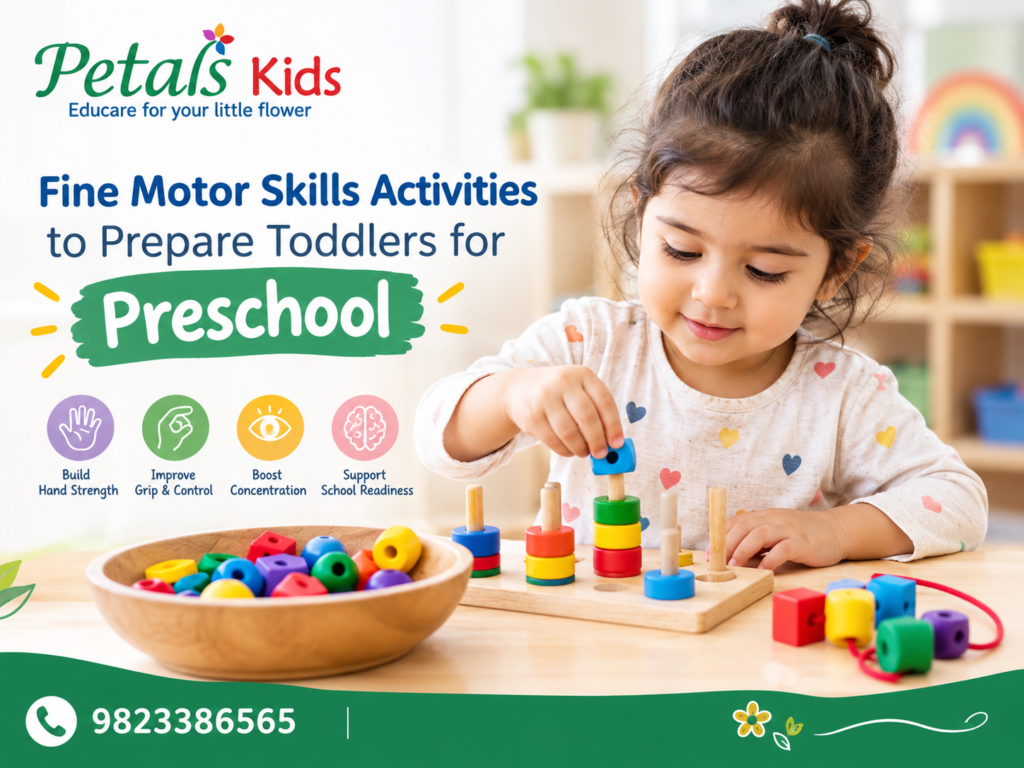
Fine motor skills activities are simple, hands-on exercises that use the small muscles in a toddler’s fingers, hands and wrists. These activities build the finger strength, hand-eye coordination and pencil grip a toddler needs on the first day of preschool. Parents who start practising these skills two to three months before enrolment usually see a smoother transition into cutting, colouring, buttoning and other classroom tasks.
What Are Fine Motor Skills and Why Do They Matter Before Preschool?
Fine motor skills are the coordinated movements of the small muscles in the hand and fingers that let a toddler hold a pencil, use scissors and manage buttons without help. These movements rely on eye-hand coordination, where visual focus and finger movement work together on a task. A preschool classroom expects a child to hold a crayon, turn book pages, snap a lunchbox shut and manage a zip largely on their own, so a toddler with practised fine motor skills settles into the daily routine with far less frustration.
Which Fine Motor Milestones Should a Toddler Reach Before Starting Preschool?
Most preschools expect a new student to manage four core movements: a pincer grip, two-hand coordination, wrist rotation and basic hand strength. We list what a typical first week looks like in our preschool, so parents can match these milestones against the daily schedule.
- Pincer grip: picking up small objects between the thumb and forefinger, the same grip used to hold a pencil.
- Two-hand coordination: holding an object steady with one hand while the other hand acts on it, the movement behind buttoning a shirt.
- Wrist rotation: turning the wrist to pour water or twist a cap, needed for independent snack time.
- Hand strength: squeezing and pressing with control, needed to open a lunchbox latch or a zip pouch.
Which Fine motor skills activities Help Toddlers Prepare for Preschool?
A short daily activity that targets one of the four milestones above builds preschool-ready hands faster than an unstructured play session.
- Playdough rolling and pinching builds the hand strength a toddler needs to grip a pencil for longer stretches.
- Bead or pasta threading trains the pincer grip and two-hand coordination used in buttoning a shirt.
- Cutting along drawn lines with child-safe scissors develops the hand control behind early writing strokes.
- Sorting buttons or pom-poms by size or colour strengthens the pincer grip while building the sorting skills preschool worksheets ask for.
- Finger painting on a large sheet of paper develops wrist control and tactile awareness without the pressure of forming letters.
- Dropping pom-poms into a narrow-necked bottle with tongs builds the grip strength needed to hold a pencil through a full worksheet.
- Peeling and sticking stickers trains the same pincer movement a toddler uses to turn the pages of a book.
- Threading a lacing card combines two-hand coordination with the seated attention a preschool circle-time activity asks for.
How Can Parents Turn Daily Routines into Fine Motor Practice Before Preschool?
Preschools expect a degree of self-help, so the fastest way to build fine motor skills is inside routines the family already has.
- Letting a toddler button their own coat or zip their own bag trains the same two-hand coordination as a threading activity.
- Handing over a small jug at mealtime for self-pouring builds wrist rotation and hand strength together.
- Asking a toddler to peel their own fruit sticker or unwrap a snack trains the pincer grip used for a pencil.
- Letting a toddler turn the pages during story time reinforces the same pincer movement teachers rely on at circle time.
How Long Before Preschool Should Parents Start Fine Motor Practice?
Consistency matters more than duration, so ten to fifteen minutes of daily practice for six to eight weeks before the term starts is generally enough to build the four core movements. Short, repeated sessions also hold a toddler’s attention better than one long weekend activity, since fine motor tasks depend on focus as much as finger strength. Our early childhood educators often share the same guidance with parents during preschool orientation.
Frequently Asked Questions
What fine motor skills should a toddler have before preschool?
A toddler should manage a pincer grip, two-hand coordination, wrist rotation and basic hand strength before preschool. These four movements cover most first-term classroom tasks, from holding a crayon to opening a lunchbox.
How can I tell if my toddler is ready for preschool in terms of fine motor skills?
A toddler is generally ready when they can pick up small objects with their thumb and forefinger, turn book pages one at a time and attempt buttons or a zip with some help. Occupational therapists treat these as the baseline movements for a first-term student.
Does screen time affect a toddler’s fine motor skill development?
Screen time itself does not directly weaken fine motor skills, but time spent on a screen is time not spent on hands-on activities like threading, cutting or playdough. Paediatric guidance generally recommends balancing screen time with active, hands-on play during the toddler years.
What if my toddler resists fine motor skills activities?
Short, five-minute sessions tied to a favourite toy or colour usually work better than a longer structured activity. Rotating between two or three activities across the week also keeps a reluctant toddler engaged without turning practice into a battle.
How many minutes a day should fine motor practice take before preschool?
Ten to fifteen minutes a day is generally enough, provided the practice is consistent through the six to eight weeks before term starts. Spreading practice across small daily sessions works better than a single long session once a week.
Conclusion
Fine motor skills activities give a toddler the finger strength, coordination and grip control that make the first weeks of preschool easier to settle into. A short daily activity, picked from the list above and repeated for six to eight weeks before term starts, builds these movements without turning practice into a chore. Parents who fold a few of these activities into everyday routines, such as self-pouring at meals or buttoning a coat, give a toddler more preschool-ready hands by the time term begins. Consistency across a few weeks matters more than any single activity on the list. Parents with questions about their toddler’s readiness can reach out to us before enrolment.

Archana Khosla is a Doctor (in Ayurvedic Medicine) by profession and an Educationist by passion. She is the favorite of every child at Petals Kids, and is patient by nature. She’s a Trained Montessori Teacher, Diploma in “Daycare Management, Certified “Parenting Coach” & “Play Therapist”, Life-time member of “Early Childhood Association” (ECA).
Archana has been in the Child Care and Education field for more than 20 years. In line with Petals vision to achieve excellence in providing progressive education & care i.e., “Educate for your little flower”. She strongly believes in continuous enhancement of her skills, as well of her team.
Dr. Archana Khosla
Archana Khosla is a Doctor (in Ayurvedic Medicine) by profession and an Educationist by passion. She is the favorite of every child at Petals Kids, and is patient by nature. She's a Trained Montessori Teacher, Diploma in "Daycare Management, Certified "Parenting Coach" & "Play Therapist", Life-time member of "Early Childhood Association" (ECA).
Archana has been in the Child Care and Education field for more than 20 years. In line with Petals vision to achieve excellence in providing progressive education & care i.e., "Educate for your little flower". She strongly believes in continuous enhancement of her skills, as well of her team.